This is a 'fun' little story from 'a long time ago' when I worked in IT security.
Introduction
The other day I got an unexpected call from a customer. They had taken a Windows server offline because it was performing a DoS attack on a Russian webshop at line-rate (1Gbit) speed and the traffic pushed away legitimate traffic to critical customer facing applications.
That was quite an incident for them and they wanted to know what happened to this server. How did it get compromised?
Over confidence
Our company was not specialised in digital forensics and I had only brief experience with it, mostly out of curiosity. I was upfront about this to the customer, but I told them that I was confident I could figure out what happened and we accepted the job.
The customer had taken the affected machine offline and either created a disk image or shared the virtual machine disk image with us. They shipped the server image on a portable hard drive to us, probably through a courier, because it was all on short notice.
Scrambling for a forensic system
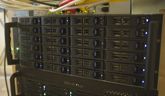
Meanwhile, I took an old HP Compaq DL380 G2 server we had lying around and stuffed it full of SCSI disks to create a RAID array on which to store the image. I'm not sure exactly why I chose to do this. Probably because we needed the storage capacity, but also because I remember that performing the analysis put a lot of stress on the storage and creating a RAID array would speed things up. I might have setup a RAID 0 just for the capacity and performance, in lieu of redundancy, which wasn't important.
We had a one gigabit network connection to the DL380 I turned into an ad-hoc forensic server and I remember that transferring the disk image onto the server took ages.
Looking for evidence
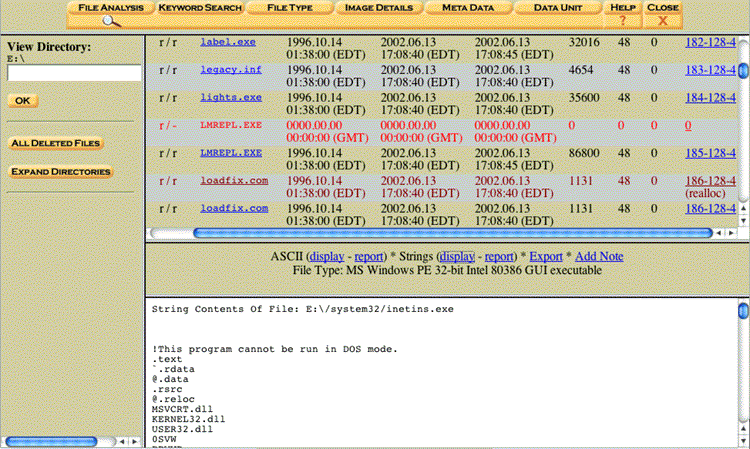
I used the The Sleuth Kit Autopsy Forensic Browser to find my way through the disk image. You may ask: to find what exactly, what are you looking for?
It's quite simple: I wanted to know what files has been created, modified or deleted on disk during the time the customer suspected the system was compromised.
As I dug deeper into the image, I was able to find several created and deleted files that showed exactly what happened and why the system was compromised. Even if you delete a file, it's not really deleted from disk. The data and meta-data is still there, only the meta-data of the file is modified to mark it as deleted.
It turned out that somebody with access to the server had installed a 'keygen' or 'crack' for a particular software product (I can't recall which software they cracked)1. Unfortunately that keygen (or crack) was infected with malware and that was how the system got compromised. This behaviour is somehting I would not expect an external attacker, I mean: why would they do this? It looked more like the unwise actions of a sysadmin.
That realisation made me feel stunned for a moment: that somebody would use a crack or keygen at their job. Crazy.
Who dun it?
Now we knew what happened, we still didn't know who did this. Still in disbelief, I copied the disk image to a computer and used a VMware product to boot the compromised disk image inside of a virtual machine (without network connectivity).
We used regular tools to reset the administrator password of the image so we could log in and look at the system logs of the windows server. There we could find with little effort which user downloaded and ran the infected executable.
The aftermath
Days later, after I finished my report and shared my findings with the customer, everything went silent. At some point I contacted the customer just to check-in, only to learn that the customer's employee - my person of contact who asked me to perform this forensic research - was no longer working with the company...
-
A keygen or key generator is a small piece of software that generates valid licence keys for software. A crack is a small piece of software that patches the software so that it does not require a licence key. ↩